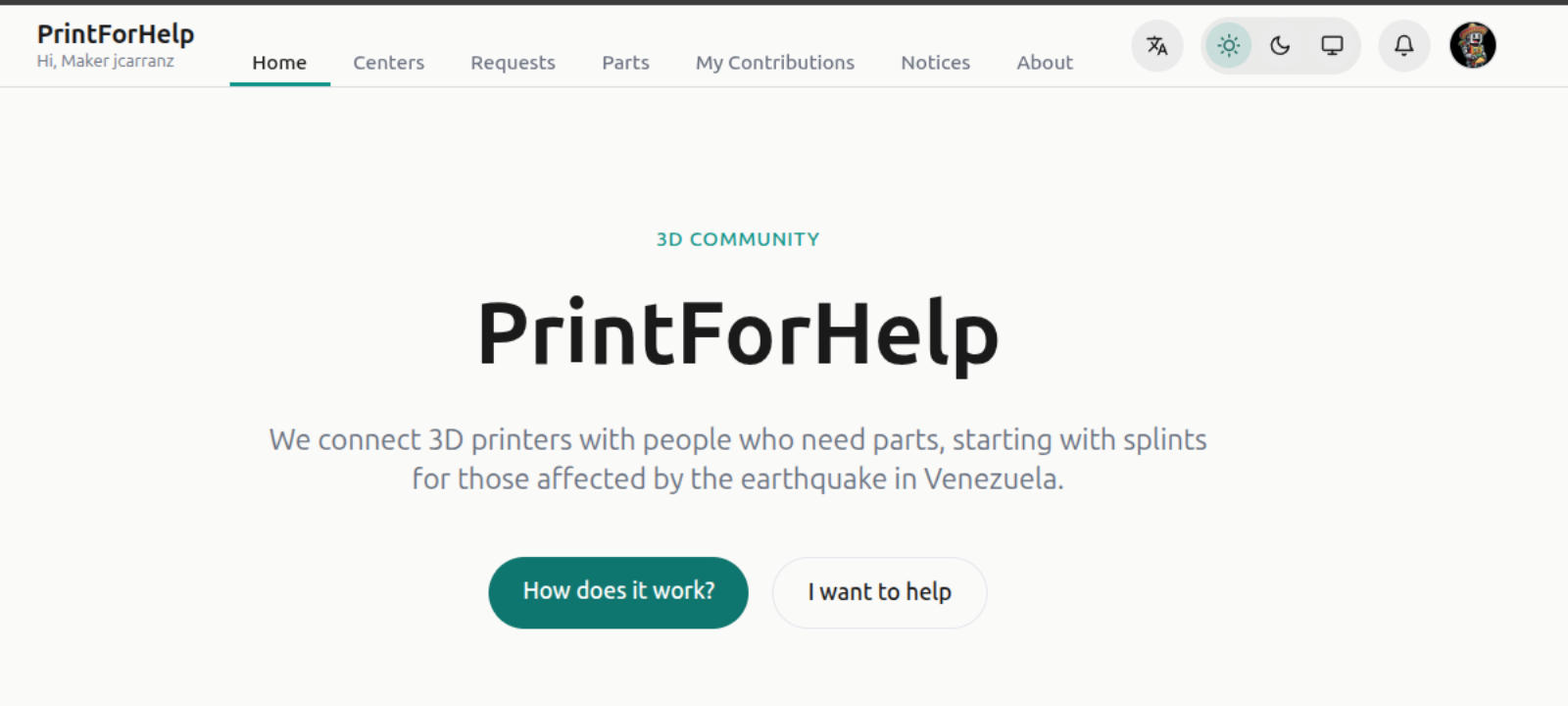
PrintForHelp
An open-source coordination platform connecting people who need 3D-printed parts with makers who own printers. Built in three days after the June 2026 Venezuela earthquake, now running at printforhelp.org.
Overview
PrintForHelp is a web platform that connects people who need 3D-printed parts with the maker community that can print and deliver them. My wife and I started it three days after the June 24, 2026 Venezuela earthquake, when the maker community was already printing medical splints for the injured — and coordinating it all in WhatsApp groups that nobody could keep up with.
The bottleneck was never print capacity. It was knowing what was needed, how many, where to send it, and who was already printing it. PrintForHelp exists to answer those four questions.
It’s a collaboration: my wife and I build the product, and RSDVELOP contributes the infrastructure the whole thing runs on — web hosting, DevOps, and security.
- Live site: printforhelp.org
- Source: github.com/jcarranz97/printforhelp (MIT)
The full story — the earthquake, how the maker community mobilized — is in the write-up linked at the bottom of this page.
What it does
Requests. Someone on the ground — a hospital, an organization, a coordinator — posts what they need: which part, how many, which material, which print settings, and packaging instructions.
Commitments. Makers browse open requests and commit to a specific quantity. Those commitments are visible to everyone, so the community can see what’s already covered and what still needs capacity. This is what stopped three people from printing the same batch while nobody printed the cervical collars.
Collection centers. A directory of verified physical drop-off points, with country, state, tags and status. Makers drop off locally and a coordinator consolidates everything into one shipment instead of forty individual packages.
Contribution tracking. Contributions move through a lifecycle — claimed → printed → prepared → delivered → received — with a maintainer confirming receipt at the end. There’s shipment tracking and generated PDF sheets of QR labels so boxes can be identified when they arrive.
Print standards. A published page of recommended filaments and settings, and the ones to avoid — carbon-fiber-filled materials, for instance, have no business against someone’s skin.
Community layer. Comments and replies, likes, user profiles and avatars, country badges, and email notifications. Sounds like fluff next to logistics, but people who see their contribution acknowledged keep contributing.
Everything is bilingual (Spanish / English), because the makers were in Venezuela, the US, Spain, Mexico and a dozen other places.
Stack
| Layer | Technology |
|---|---|
| Backend | FastAPI (Python 3.13) + SQLAlchemy |
| Database | PostgreSQL 15 |
| Frontend | Next.js 15 + React 19 + Tailwind v4 + HeroUI |
| Docs | MkDocs Material |
| Dev / deploy | Docker Compose · Kubernetes |
| CI | GitHub Actions (path-filtered jobs) |
Role-based access control with three roles — user, maintainer, admin. Maintainers
verify collection centers, moderate the parts catalog, and confirm deliveries. Trust
matters when the end product is a medical device.
Hosting, deployment and security are handled by RSDVELOP, who came on board as infrastructure partner. Not having to think about servers, uptime or hardening is a large part of why a two-person side project could ship this fast.
Status
Live and in active development. The near-term goal is to generalize beyond the earthquake response into a standing hub for community-driven 3D-printed humanitarian aid.