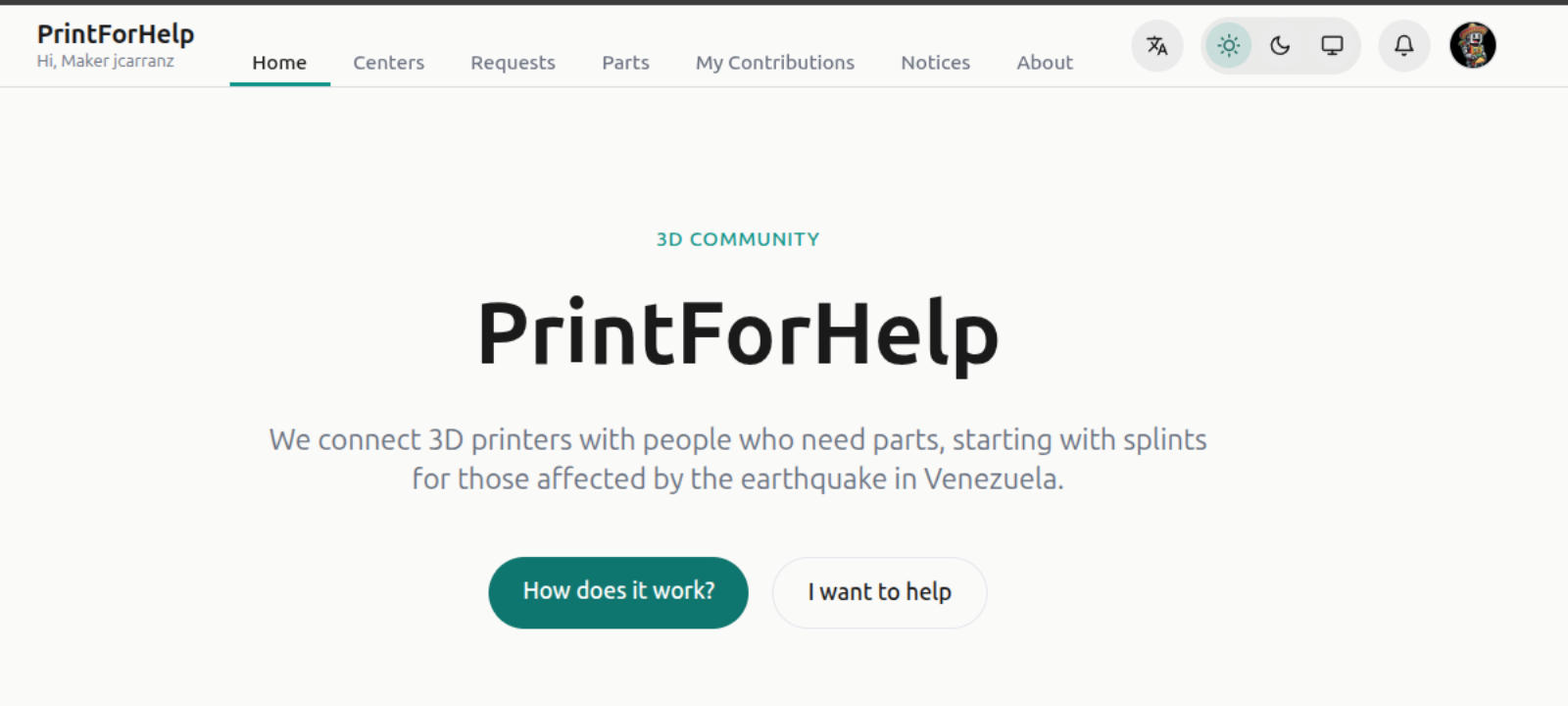
PrintForHelp: what my wife and I built after the Venezuela earthquake
On June 24 two earthquakes hit northern Venezuela. Within days the maker community was printing splints for the injured — and drowning in WhatsApp messages. This is how we ended up building a platform to organize it.
I don’t usually write about anything other than circuits, firmware, and whatever is on the print bed. This one is different. It’s about the month after a disaster, a community of strangers with 3D printers, and a website my wife and I built at night because the coordination was falling apart in group chats.
What happened
On June 24, 2026 at 18:04 local time, a magnitude 7.2 earthquake struck about 23 km from San Felipe, in the state of Yaracuy, northern Venezuela. Thirty-nine seconds later a second, stronger quake — magnitude 7.5 — hit near Yumare, at a shallower depth of 10 km. Together the shaking lasted roughly three minutes. It was felt in Colombia, Trinidad and Tobago, and parts of Brazil.
The damage was concentrated in La Guaira, Caracas and the Capital District, and spread through Falcón, Yaracuy, Miranda, Aragua and Carabobo. Hundreds of buildings collapsed. Hospitals, churches and the Simón Bolívar International Airport were damaged. As of this writing the reported toll is in the thousands of dead and tens of thousands of injured, with figures still moving as recovery continues. More than 30 countries sent rescue teams and aid.
Numbers like those are hard to hold in your head. What made it concrete for me was much smaller: thousands of people with broken bones, and hospitals that had run out of splints.
The maker community moved first
Within about 48 hours, something remarkable happened. Ostec3D, a Venezuelan venture that makes 3D-printed orthotics, published their thermoplastic splint files publicly — just a shared Google Drive folder, free for anyone to download. Somos Layer Lab, a Venezuelan 3D-printing distributor, mobilized from the epicenter alongside them.
The clever part was a design decision. Instead of printing splints as curved shells, they redesigned them to print completely flat, then be molded directly onto the patient’s limb with hot water. That one change:
- Cut print time to less than half
- Let you fill an entire print bed instead of wasting it on curves and supports
- Fit far more pieces into a single shipment
Finger, hand, elbow, arm and foot splints, plus cervical collars for adults and children. In under 96 hours, a network of makers, distributors, independent workshops and companies had covered the immediate demand for hospitals in Caracas and La Guaira. Bambu Lab even ran a 48-hour charity campaign in support of the response.
If you have ever wondered whether a hobbyist 3D printer is “actually useful” — that’s the answer. A room full of consumer printers turned into a distributed medical supply chain in four days.
And then the chaos
Here’s the part nobody puts in the press release.
All of that coordination was happening in WhatsApp groups. Hundreds of people, several groups, messages scrolling past faster than anyone could read them. The result was exactly what you’d expect:
- Duplicated work. Three makers printing the same 40 finger splints, while nobody printed the cervical collars.
- No visibility on need. Makers had no way to know what was most needed right now, or in which city.
- No idea where to send anything. Drop-off points were shared as a message that got buried twenty minutes later.
- Quality drift. People printing in whatever filament they had on the shelf — some of it genuinely unsafe for a part that touches a fractured limb.
- Broken links. The design files lived in a Drive folder shared by forwarding a screenshot of a screenshot.
Enormous goodwill, almost zero structure. The bottleneck was never print capacity — it was coordination.
Building PrintForHelp
My wife and I started talking about it on the evening of June 26. The first commit landed on June 27, three days after the earthquake.
The initial version was deliberately unglamorous: a landing page that hosted the splint designs in one stable place, explained the print standards, and listed where to send finished parts. That alone killed a surprising amount of the confusion.
Then it kept growing. Over the following month it turned into a real coordination platform — the full feature list and the stack are on the project page, but two ideas did most of the work.
Commitments fixed the duplicated printing. A maker browses the open requests and commits to a specific quantity, and that commitment is visible to everyone. Suddenly the community could see what was already covered and what still needed capacity — the exact question the group chats could never answer.
Collection centers fixed the logistics. Instead of forty makers each mailing an individual package to an address someone half-remembered, there’s a directory of verified drop-off points. You print, you drop off locally, a coordinator consolidates everything and ships once.
Everything after that — the contribution lifecycle, QR labels for the boxes, the published print standards, comments and notifications — grew either out of those two ideas or out of someone in a group chat saying “I can’t figure out X.” It’s bilingual from day one, because the makers were in Venezuela, the US, Spain, Mexico and a dozen other places.
The part we didn’t have to build
We’re not doing this alone. RSDVELOP joined as infrastructure partner and contributes the layer underneath everything: web hosting, DevOps, and security. That’s not a small donation. Two people writing features at night are in no position to also run production servers, keep uptime honest, and harden an app that stores real people’s names, addresses and shipment details. Having a company absorb that meant we could spend our evenings on the coordination problem instead of on infrastructure — and it meant the platform was properly secured from the start rather than “we’ll get to it.”
It’s open source under MIT — github.com/jcarranz97/printforhelp. Roughly 87 pull requests in the first month, mostly at night after work.
What I learned
The hard problem was never technical. FastAPI and Next.js are the easy part. The hard part was modeling how help actually flows: who verifies a need is real, who decides a design is appropriate, how a part gets from a printer in another country to a specific person’s arm. We ended up writing that flow down as an explicit document before writing much of the app, and I’m glad we did.
Ship the ugly version immediately. The first thing we deployed was basically a page with links. It was useful on day one. Every good feature after that came from someone in a WhatsApp group saying “I can’t figure out X.”
Visibility is the product. Nearly every feature that mattered — commitments, tracking, status chips, the contributions page — exists to answer one question: what is already being handled, and what isn’t? Communities are great at generating effort and terrible at allocating it. Software can fix the second part.
Open the files. Ostec3D and Somos Layer Lab could have kept those designs. They published them for free, in the middle of a disaster, and hundreds of people printed them. That decision is the reason any of the rest happened.
Contributing isn’t only printing. The most useful help we got wasn’t a printed part. Ostec3D and Somos Layer Lab gave away the designs; RSDVELOP gave the infrastructure; coordinators gave the boring logistics work of consolidating boxes. Everyone has some capacity that happens to be exactly the thing someone else is blocked on — it’s rarely the obvious one.
If you want to help
The project is still running, and it’s not limited to this one emergency — the goal is a general-purpose hub connecting people who need printed parts with people who own printers.
- Site: printforhelp.org
- Code: github.com/jcarranz97/printforhelp
- Instagram: @printforhelp
If you own a 3D printer, you can browse open requests and commit to a quantity. If you write code, the issues are open. And if you’re near a collection center, that’s a real contribution too — logistics is where most of these efforts die.
The printer on my desk was bought to prototype enclosures and brackets. It turns out it does other things.
Casualty and damage figures cited here reflect what was reported at the time of writing and are likely to be revised.
Sources: Terremotos de Venezuela de 2026 — Wikipedia · ReliefWeb situation overview · Bambu Lab 48-hour charity campaign · Community coverage of the splint effort